
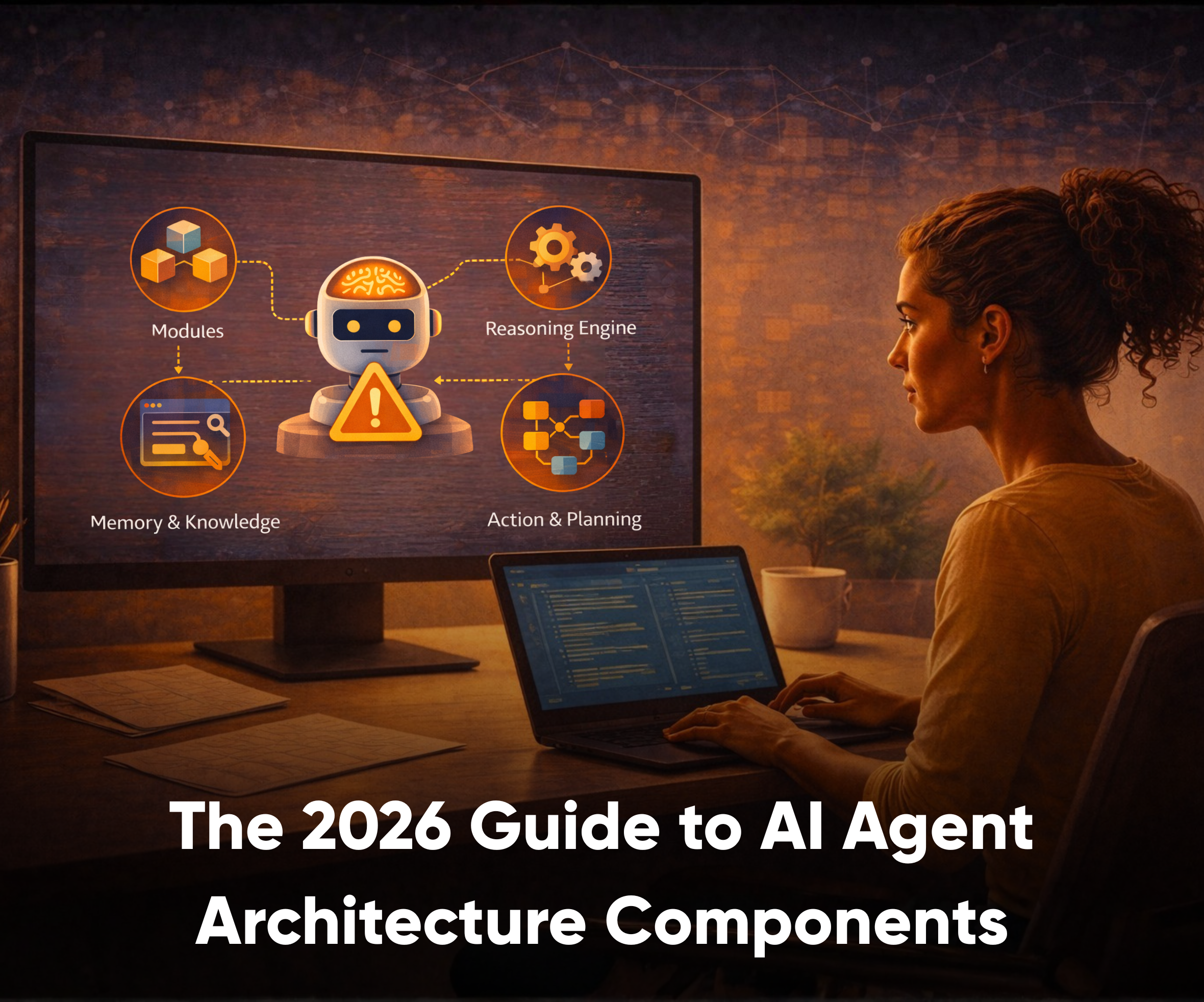

AI Agent Architecture is what transforms a “smart response” into a system that can safely take action within real-world product workflows. Once AI agents can plan steps, call tools, and update systems of record, the work shifts from prompt-writing to designing artificial intelligence systems you can trust.
In practice, AI Agent Architecture serves as the blueprint for how an agent thinks, acts, and remains accountable for where context originates, how decisions are routed, how tools are invoked, and what happens when something fails. If an AI architecture diagram has ever felt like “just boxes,” this guide makes those boxes concrete experience, control, and execution so teams can align on the architecture of an AI agent before shipping.
By the end, you’ll be able to describe a clear AI agent system architecture, spot missing layers (permissions, guardrails, observability), and understand why layered agent architecture in AI matters more than model choice when reliability is the goal.
What Is AI Agent Architecture
AI Agent Architecture is the system design that lets AI agents do more than generate text. It defines how an agent plans work, uses tools, pulls the right context, and stays safe while operating inside real artificial intelligence systems. In other words, AI Agent Architecture is the difference between “a model that answers” and an AI Agent system architecture that executes.
If you’ve seen an AI architecture diagram that looks clean on a slide but breaks in production, it usually missed one of these fundamentals:
- A clear control layer that decides what happens next and when to stop.
- A reliable tool layer for actions (your application programming interface (API) calls, databases, and apps).
- Grounding for facts via data access and retrieval, often retrieval-augmented generation (RAG).
- Guardrails for permissions, approvals, and escalation paths.
In 2025, adoption is accelerating, but so are the failure modes. According to an AI report, found 52% of executives say their organizations are deploying AI agents in production.
At the same time, Gartner warned that over 40% of agentic AI projects will be canceled by the end of 2027 due to escalating costs, unclear business value, or inadequate risk controls
A practical way to think about the architecture of ai agent is a layered model: experience, control, and execution. This “layered agent architecture in AI” makes accountability easier, failures easier to trace, and iteration safer as your ai architecture evolves.

The Layered AI Architecture Diagram Most Teams Should Start With
A useful AI Agent Architecture isn’t a complicated maze of boxes; it’s a layered system where responsibility is clear. The simplest AI architecture diagram to align product, design, and engineering is a three-layer view: what the user experiences, what controls the agent’s behavior, and what actually executes work in your stack.
This “layered agent architecture in AI” helps you build AI agents that are reliable, governable, and easy to debug.
Layer 1: Experience Layer (What Users See And Control)
This is where trust is designed. In a good AI Agent Architecture, the UI makes it obvious what the agent is doing, what it’s about to do, and how the user can intervene.
- Visibility: steps, status, and progress
- Controls: confirm, edit, undo, stop, escalate
- Expectations: what the agent can’t do (explicitly)
Layer 2: Control Layer (How The Agent Thinks, Decides, And Stops)
This is the “brain + rules” of your AI agent system architecture, the part that manages the loop: plan → act → observe.
- Orchestration: task state, retries, timeouts, fallbacks
- Policy: permissions, approvals, guardrails
- Routing: when to call tools vs. when to ask the user vs. when to hand off

Layer 3: Execution Layer (Where Work Actually Happens)
This is the tool and data layer of the architecture of AI agents, the systems your agent reads from and writes to.
- Tools: APIs, internal services, SaaS integrations
- Data: databases, knowledge bases, retrieval pipelines
- Logging: every action is recorded for audit and debugging
If you’re building artificial intelligence systems that touch real workflows, this layered AI agent architecture is the baseline. Everything else – multi ai agent architecture, specialized sub-agents, advanced memory – should be added only after these layers are solid.
Top 8 Core Components of AI Agent Architecture
If you’re planning AI agent development, these are the layers your AI Agent Architecture needs before you scale tools, autonomy, or scope. A production-ready AI Agent Architecture isn’t “LLM + prompt” it’s a system where AI agents can act without becoming unsafe or unpredictable.
In an AI architecture diagram, these components are the minimum set that prevents the most common failures in real artificial intelligence systems.
1. The Experience Layer (Where Trust Is Built)
AI Agent Architecture starts in the interface because this is where users decide whether the system is credible or reckless. Most “agent failures” look like model problems, but they’re often UX failures: unclear boundaries, invisible steps, or no way to intervene when the agent is wrong.
What it includes
- Clear capability boundaries (“can/can’t do”): State the contract upfront. Can it only read data, or can it also write? Can it message customers? If boundaries aren’t explicit, users will assume the risky version.
- Step visibility (what it’s doing and why): Show intent, not inner thoughts. “Searching policy,” “Pulling account details,” “Drafting response,” “Waiting for approval,” “Updating CRM” make the workflow legible.
- Controls: confirm, edit, undo, stop, escalate: Confirm high-impact actions, allow edit-before-send, support undo where possible, and provide a true stop plus escalation.

For example, reMarkable launched “Mark,” an Agentforce-powered support agent in three weeks, handling 25,000+ customer conversations – proof that visibility, clear boundaries, and intervention controls are foundational to AI Agent Architecture.
What to cover
- Trust calibration: Signal uncertainty when inputs are missing, sources conflict, or permissions block access.
- Partial completion UX: Show what was completed, what failed, what’s pending, and offer next actions like retry, hand off, or export a summary.
2. Orchestration (The System That Runs the Agent)
Without orchestration, you don’t have an agent; you have a sequence of guesses. Orchestration is the runtime that turns ai agents into a controllable process: it maintains state, routes steps, and enforces stopping conditions. In AI Agent Architecture, this is the difference between “it usually works” and “it works predictably.”
Responsibilities
- Task state + history: Track the goal, steps attempted, tool responses, and decisions.
- Step routing (planner vs executor): Separate proposing steps from executing them, so tool calls stay ordered.
- Timeouts, retries, fallbacks: Define retry limits, graceful degradation, and when to escalate instead of looping.
For example: An e-commerce rollout followed a staged path (sandbox → secondary sandbox → production) and reduced agent workload by 20%, showing why orchestration and controlled migration are part of AI Agent Architecture, not “implementation details.”
- Budgeting (cost/latency limits): Cap steps, tool calls, and runtime.

Two common orchestration patterns
- Agentic workflows (structured paths; lower risk): intake → retrieve → draft → confirm → execute.
- Autonomous agents (open-ended; higher risk): flexible, but demand tighter budgets, approvals, and monitoring.
3. The Model Layer (Reasoning, Not Execution)
In AI Agent Architecture, the model should act as the decision engine, not the system that directly “does the work.”
The fastest way to make AI agents unreliable is letting the model blur roles, planning, executing, validating, and explaining without boundaries. A clean AI agent system architecture uses the model to decide what to do next, while orchestration controls whether it should happen and tools handle how it happens.
What it includes
- Role separation: planner (creates steps), executor (selects tools/actions), verifier (checks outputs).
- Structured outputs: schemas and constrained formats so downstream systems can act safely.
- Decision policies: when to proceed, when to ask a question, when to escalate.

What to cover
- Reliability levers: deterministic settings where needed (lower randomness), consistent prompting, and clear stop conditions.
- Model fallbacks: what happens when the “best” model is slow, unavailable, or too expensive.
- Validation mindset: the model proposes; the system verifies—especially in artificial intelligence systems with real-world consequences.
4. Tools & Integrations (Where Agents Become Useful)
Tool design determines whether your agent is safe and reliable. Tools are how ai agents touch the real world: internal APIs, databases, third-party SaaS. 1-800Accountant reported Agentforce autonomously resolved 70% of administrative chat engagements during critical tax weeks in 2025 – a strong reminder that “good tools” (schemas, least-privilege access, audit logs) make or break AI Agent Architecture at scale.
In a multi-ai agent architecture, tools become shared infrastructure, so one sloppy tool interface can create systemic risk across many agents.
What “good tools” look like
- Strict input/output schemas (typed parameters, structured responses).
- Least-privilege permissions (no broad “god access”).
- Audit logs (what changed, when, and by whom).
- Rate limits + safe retries (clear error handling rules).

Examples of tools (by category)
- Read tools: search, fetch, retrieve, query a database.
- Write tools: create a ticket, update a CRM record, send a message (higher risk).
- Transform tools: summarization, extraction, classification.
In multi ai agent architecture, treat tools as shared infrastructure: one loosely designed integration can affect multiple agents.
5. Data Retrieval (RAG) and Grounding
If the agent needs to be right, it needs sources, not vibes. Retrieval is how AI Agent Architecture connects model output to real, current truth – policy docs, product specs, customer records, knowledge bases.
This is especially important as the AI agent market pushes teams to ship faster than their documentation and data pipelines can keep up.
When to use retrieval vs memory vs fine-tuning (high-level)
- Retrieval: current facts, policies, knowledge bases.
- Memory: preferences and prior decisions (continuity, not truth).
- Fine-tuning: consistent style/format or narrow tasks (use cautiously).

Common grounding failures (awareness-stage)
- Stale documentation (wrong version, incorrect output).
- Permissioned data gaps (retrieval returns nothing; agent guesses unless you block).
- Conflicting sources (no tie-break rule or escalation).
6. Memory (Short-Term, Long-Term, and “Don’t Store This”)
“Memory” is three different problems; treat it that way. In AI agent architecture, memory impacts personalization, compliance, and long-term reliability. Poor memory design creates silent failure: the agent is “helpful,” but gradually becomes wrong.
Memory types
- Short-term: in-task context needed to finish the current job.
- Long-term: consented preferences (defaults, formatting, stakeholders).
- Organizational memory: policies, playbooks, standard operating procedures.

Memory pitfalls
- Storing sensitive data by accident.
- Treating old preferences as truth without review.
- No expiration/correction path (memory needs lifecycle: edit, reset, decay).
7. Guardrails, Permissions, and Human-in-the-Loop
The moment an agent can act, you’re shipping governance. Guardrails are the controls that keep ai agents useful without becoming dangerous. In practical AI Agent Architecture, guardrails aren’t a single filter; they’re layered checks around tools, data, and outputs.
Guardrail layers
- Input filtering (prompt injection and policy checks).
- Tool gating (approval flows for risky actions).
- Output checks (format, claims, compliance constraints).

Human handoff design
- Handoff in UX + logs: what’s done, what’s blocked, and what decision is needed next.
- Escalation playbooks: who owns the case, when to page them, what context to include.
8. Observability and Evaluation (How You Stop Regressions)
If you can’t trace it, you can’t improve it. Observability is the maintenance layer of AI Agent Architecture. It’s how you turn unpredictable behavior into diagnosable issues across your layered agent architecture in AI.
What to log and trace
- Tool calls + parameters + results.
- Key decision artifacts (selected plan, chosen tool, escalation trigger).
- Costs, latency, failure rate, escalation rate.

Evaluation basics (awareness-stage)
- Golden tasks (repeatable test set).
- Regression checks after prompt/tool/data changes.
- Failure taxonomy (what broke: retrieval, tool, policy, UX).
A strong AI Agent Architecture is the sum of these layers working together. When experience, orchestration, model behavior, tools, retrieval, memory, guardrails, and observability are designed as one system, AI agents become shippable, governable, and resilient in real artificial intelligence systems.
Conclusion
At the end of the day, AI Agent Architecture is what makes AI agents trustworthy in real workflows. Models will change, but the system you design around them – experience, orchestration, model layer, tools, retrieval, memory, guardrails, and observability – determines whether an AI agent system architecture is shippable and safe inside real artificial intelligence systems.
If you’re deciding what’s realistic to automate (and what’s risky), it helps to pressure-test your AI Agent Architecture early. As an AI development company, we can help you map the right starting point and avoid common production pitfalls – book a 15/30-minute free consultation.
FAQs
What are the core components of an AI agent system architecture?
Most AI agent system architecture designs include: experience layer, orchestration, model layer, tools/integrations, retrieval (RAG), memory, guardrails, and observability/evaluation.
How do you evaluate and monitor AI Agent Architecture in production?
Track tool calls, step outcomes, latency, cost, failure rate, and escalation rate, and maintain golden test cases to catch regressions after changes to prompts, tools, or data.


