
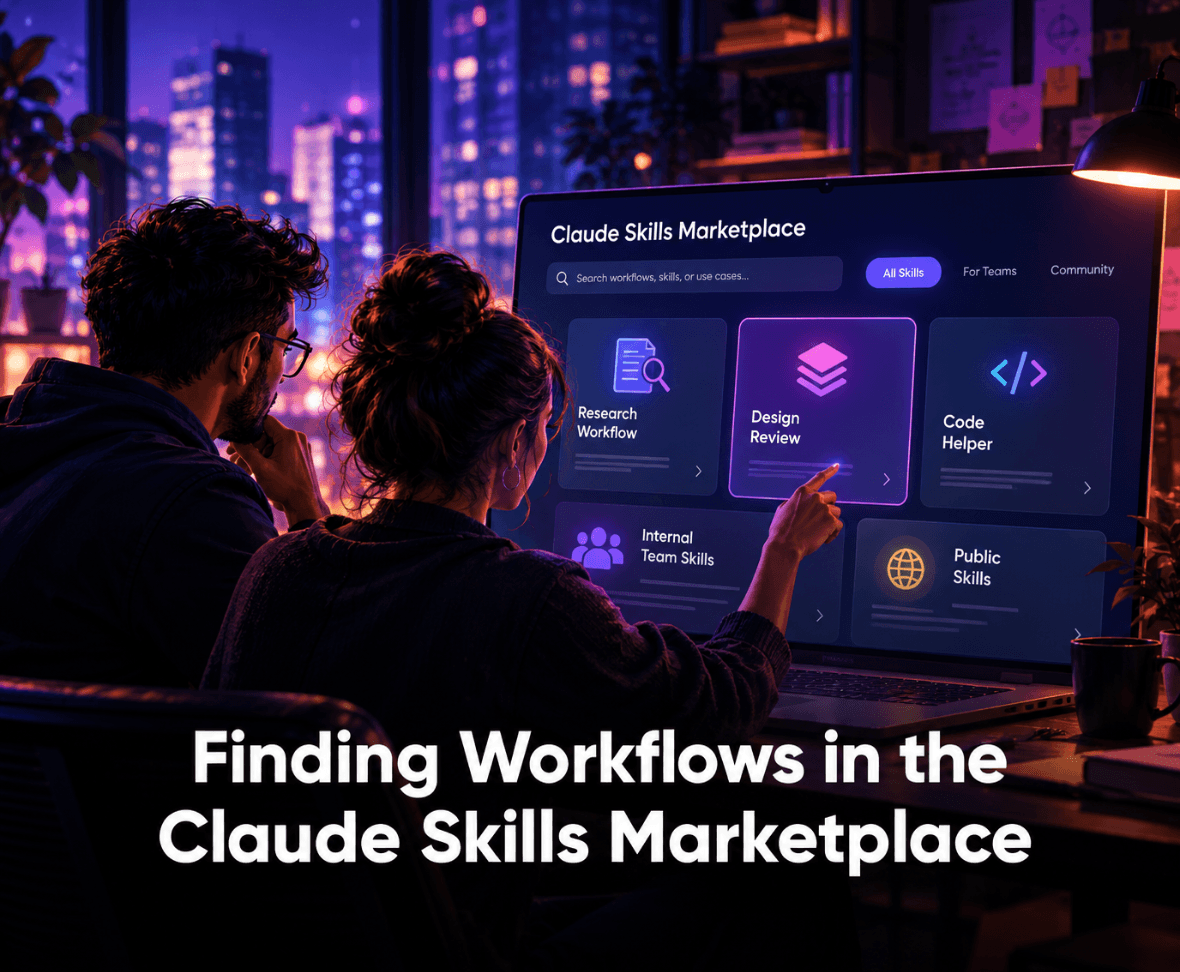

AI teams do not have a prompt shortage. They have a repeatability problem. The Claude Skills Marketplace ecosystem is growing because teams want reusable workflows they can trust instead of rebuilding instructions every time a task starts.
The difficult part is not finding Skills. It is deciding which ones deserve to enter a real workflow. A Skill can contain instructions, scripts, references, dependencies, and assumptions that shape how Claude works with tools and data.
This article explains where teams are finding Claude Skills, how public and internal Skills differ, what provenance and quality checks matter, and how reusable operational knowledge changes the way teams work with AI.
TL;DR
-
Claude Skills package repeatable instructions, resources, scripts, and workflow knowledge so Claude can apply them when relevant.
-
Teams are discovering Skills through Claude’s directory, Anthropic’s GitHub repository, community collections, and internal organization libraries.
-
Public Skills work best for transferable methods, while internal Skills are better suited to company-specific workflows, standards, and operating knowledge.
-
Provenance matters because Skills can influence tool use, code execution, file access, and other actions inside an AI workflow.
-
The most valuable Skill library is not the largest one. It is the one with clear ownership, review, testing, versioning, and retirement rules.
What Is the Claude Skills Marketplace?
The Claude Skills Marketplace is better understood as an ecosystem than a single storefront.
Anthropic defines Agent Skills as folders containing instructions, scripts, and resources that Claude loads when they become relevant to a task. The model does not need the full workflow in every prompt. Instead, the Skill supplies procedural knowledge when the task calls for it.
That creates several discovery paths.
Claude now supports built-in Skills, custom Skills, organization-provisioned Skills, and partner Skills. The directory also includes professionally built Skills from companies such as Notion, Figma, and Atlassian.
Teams can also discover public Skills through GitHub, curated community collections, and third-party directories.
This is why the term “marketplace” can be misleading. The real landscape includes official Skills, public repositories, partner integrations, community-built resources, and private organizational libraries.
Anthropic’s introduction to Agent Skills gives the clearest definition of the underlying model.

Where Are Teams Finding Claude Skills?
Teams usually discover Skills through four routes. Each serves a different purpose.
| Discovery source | Best for | Main advantage | Main consideration |
|---|---|---|---|
| Claude Skills directory | Fast installation | Low-friction discovery inside Claude | Review behavior before broad adoption |
| Anthropic GitHub repository | Inspectable examples | Source files and implementation patterns are visible | Examples still require testing |
| Community repositories and directories | Niche workflows | Wider variety of use cases | Quality and maintenance vary |
| Internal organization library | Company-specific workflows | Controlled distribution and governance | Requires ownership and review |

1. Claude’s Skills directory
Claude’s directory gives teams the lowest-friction discovery path.
Users can browse available Skills directly inside Claude. Team and Enterprise organizations can also surface organization-approved Skills alongside other available capabilities.
This matters because Skills no longer have to remain a developer-only concept. Operations, marketing, product, design, and research teams can interact with reusable workflows without managing repositories themselves.
The directory is useful for discovery. It should not replace review.
2. Claude Skills GitHub repositories
Claude Skills GitHub searches serve a different audience.
Anthropic maintains a public repository that exposes Skill folders, SKILL.md files, scripts, supporting resources, and implementation patterns. That transparency makes GitHub useful when technical teams want to understand how a Skill actually works before adopting it.
GitHub also gives teams context around authorship, changes, issues, pull requests, and maintainers.
That makes a Claude Skills repository more than a download location. It becomes a source of provenance.
Teams exploring public implementations can start with the official repository.
3. Curated Claude Skills directories
Searches for best Claude Skills, Claude Skills directory, Claude Skills library, and similar terms reveal another need: curation.
Teams do not want to review every Skill ever published. They want a smaller set that appears relevant to a specific job.
Curated directories can help narrow that search.
But popularity is not the same as suitability.
A Skill that works well for an independent developer may not fit an enterprise workflow with restricted data, review gates, or compliance requirements.
Directories should shorten discovery. They should not make the adoption decision.
4. Internal Skill libraries
Internal Skills solve a different problem entirely.
Anthropic lets Team and Enterprise organizations provision Skills to users, distribute them to specific groups, control who can create Skills, and publish approved workflows into an organization library. Enterprise organizations can also add review and security scanning controls.
That moves Skills from personal productivity into organizational infrastructure.
A company can standardize how a marketing team prepares campaign briefs, how a product team reviews requirements, or how an operations team turns meeting notes into structured tasks.
The Skill becomes a reusable version of the team’s operating method.
Public vs. Internal Claude Skills: What Belongs Where?
The clearest distinction is this: public Skills should encode transferable methods, while internal Skills should encode company-specific knowledge or process.

A public Skill makes sense when the workflow remains useful outside one organization.
Examples include document processing, research workflows, accessibility checks, generic API procedures, structured analysis methods, or reusable coding conventions.
Internal Skills are more valuable when performance depends on how a specific company works.
That might include:
-
Product review processes with company-specific approval criteria.
-
Design-system workflows that reference internal components and standards.
-
Marketing processes that encode brand voice, claim rules, and publishing checks.
-
Sales operations that follow a company’s exact qualification and CRM conventions.
-
Engineering procedures that document deployment, incident, or repository rules.
Anthropic explicitly describes organizational knowledge capture as a core use case for Skills. It also lists examples such as company communication templates, task-creation conventions, and company-specific data workflows.
This is the same reason Agent Skills make team know-how reusable rather than simply storing more instructions. ProCreator’s work on this topic explains how repeatable workflows can package instructions, references, scripts, templates, and decision rules around recurring work.
Why Does Provenance Matter in the Claude Skills Marketplace?
A Skill is not just a saved prompt.
It can contain instructions, scripts, references, dependencies, and executable behavior. That makes provenance a practical security and reliability concern.
Anthropic’s own repository guidance warns that repository-hosted Skills sit inside the agent’s trust boundary. Anyone who can change a mounted repository can potentially change the instructions the agent receives.
That means teams need to ask more than, “Does this look useful?”

They should ask:
-
Who created it? Confirm the author, repository owner, and maintainer.
-
What can it execute? Inspect scripts, packages, commands, and tool interactions.
-
What data can it touch? Check files, APIs, connectors, and external services.
-
How is it maintained? Look for update history, ownership, and known issues.
-
Can the source be inspected? Avoid treating opaque packages as automatically trustworthy.
-
Has your team tested it? A Skill should prove itself against representative tasks before broad distribution.
This matters even more when Skills interact with code execution, connected systems, or proprietary information.
Anthropic’s organization controls reinforce that principle through review workflows, fixed submitted versions, security scanning, version history, and controlled publication.
How Should Teams Quality-Check Claude Skills?
Claude Skills best practices should focus on repeatability, not one impressive output.
Anthropic recommends concise, well-structured Skills that teams test through real usage. It also uses progressive loading so Claude reads deeper Skill content only when the workflow requires it.
For teams, that translates into five checks.
1. Test trigger accuracy
The Skill description affects when Claude decides to use it.
Test prompts that should activate the Skill and prompts that should not. A workflow that triggers too broadly can interfere with unrelated work.
2. Test the workflow across different inputs
One successful run proves very little.
Use representative cases, edge cases, incomplete inputs, conflicting information, and unusual task conditions.
The goal is predictable behavior, not a polished demo.
3. Review dependencies and permissions
Treat executable Skill resources like code.
Review packages, scripts, external calls, filesystem access, and connected systems before adoption.
Anthropic’s best-practice guidance provides the most direct reference for designing and testing effective Skills.
4. Assign an owner
Every internal Skill should have someone responsible for accuracy.
Workflows change. APIs change. Internal rules change. A Skill with no owner can preserve an obsolete process with more consistency than a human ever could.
That makes stale automation particularly dangerous.
5. Version high-impact Skills
A workflow used by five people and a workflow used by five hundred should not have the same release discipline.
High-impact Skills need version history, review, testing, and rollback thinking.
Anthropic’s organizational publishing model already reflects this approach. Updated versions can move through review before they replace an approved version.
Why Reusable Operational Knowledge Matters More Than More Prompts
The bigger opportunity is not another repository of AI instructions.
It is turning operational knowledge into something reusable at the point of work.

Most organizations already have valuable procedures. They sit across Notion pages, Google Docs, checklists, onboarding decks, project templates, chat threads, and the memories of experienced employees.
The problem is retrieval.
People have to remember that the process exists, find the right document, interpret it correctly, and apply it consistently.
Skills can bring the method closer to the task itself.
A product team reviewing an AI feature, for example, could encode its privacy, UX, analytics, accessibility, and approval checks into a reusable workflow. The Skill does not replace judgment. It makes the agreed process harder to skip.
This principle also applies to AI in product development more broadly. AI creates more value when teams start with a clear workflow, a defined outcome, and known review points rather than inserting automation into every available task.
That distinction matters.
A Skill library should not become a warehouse for every procedure a company has ever written.
Teams should start with workflows that are repeated often, understood well, and easy to evaluate.
What Makes a Claude Skills Library Worth Maintaining?
A strong Claude Skills library does not win by volume. It wins by trust.
Every Skill should have a purpose, source, owner, risk level, review status, version, test set, and retirement condition.

That creates a simple operating model:
-
Discover a workflow worth reusing.
-
Inspect its source and dependencies.
-
Test it against representative work.
-
Approve it for a defined group or use case.
-
Maintain it as the underlying process changes.
-
Retire it when the workflow no longer deserves automation.
The marketplace solves discovery. Governance turns discovery into reliable operations.
Conclusion: The Real Value Is the Knowledge Behind the Skill
The Claude Skills Marketplace makes reusable AI workflows easier to find. But discovery is only the first step. Teams still need to decide which Skills they can trust, which workflows deserve standardization, and which knowledge should remain internal.
The advantage will not come from installing more Skills. It will come from turning the right operating knowledge into repeatable systems without removing the judgment, ownership, and review that made the process valuable in the first place.
Start with workflows your team already repeats and understands. Define the expected result, the review points, the data boundaries, and the owner before you scale the Skill across the organization.
If your team is deciding which workflows are worth turning into reusable AI systems, ProCreator’s AI Innovation Strategy helps identify high-value AI opportunities, define where automation creates real value, validate the concept, and build a practical path from experimentation to implementation.
FAQs
Where can teams find Claude Skills on GitHub?
Anthropic maintains an official public repository containing Agent Skill examples and implementation patterns. Teams can also discover third-party repositories, but they should review ownership, files, dependencies, maintenance history, and permissions before adoption.
What is the difference between public and internal Claude Skills?
Public Skills usually package methods that apply across organizations. Internal Skills encode company-specific workflows, standards, processes, and institutional knowledge that should remain controlled within the organization.
How should teams evaluate the best Claude Skills?
Evaluate provenance, workflow fit, source files, dependencies, permissions, update history, and test performance. The strongest Skill is not necessarily the most popular one. It is the one that performs a repeatable task predictably inside your operating environment.
Are Claude Skills safe for enterprise use?
Skills can support enterprise workflows, but discovery alone does not guarantee safety. Teams should review third-party Skills, test them before distribution, limit permissions, assign ownership, and use organizational review and security controls where appropriate.


