
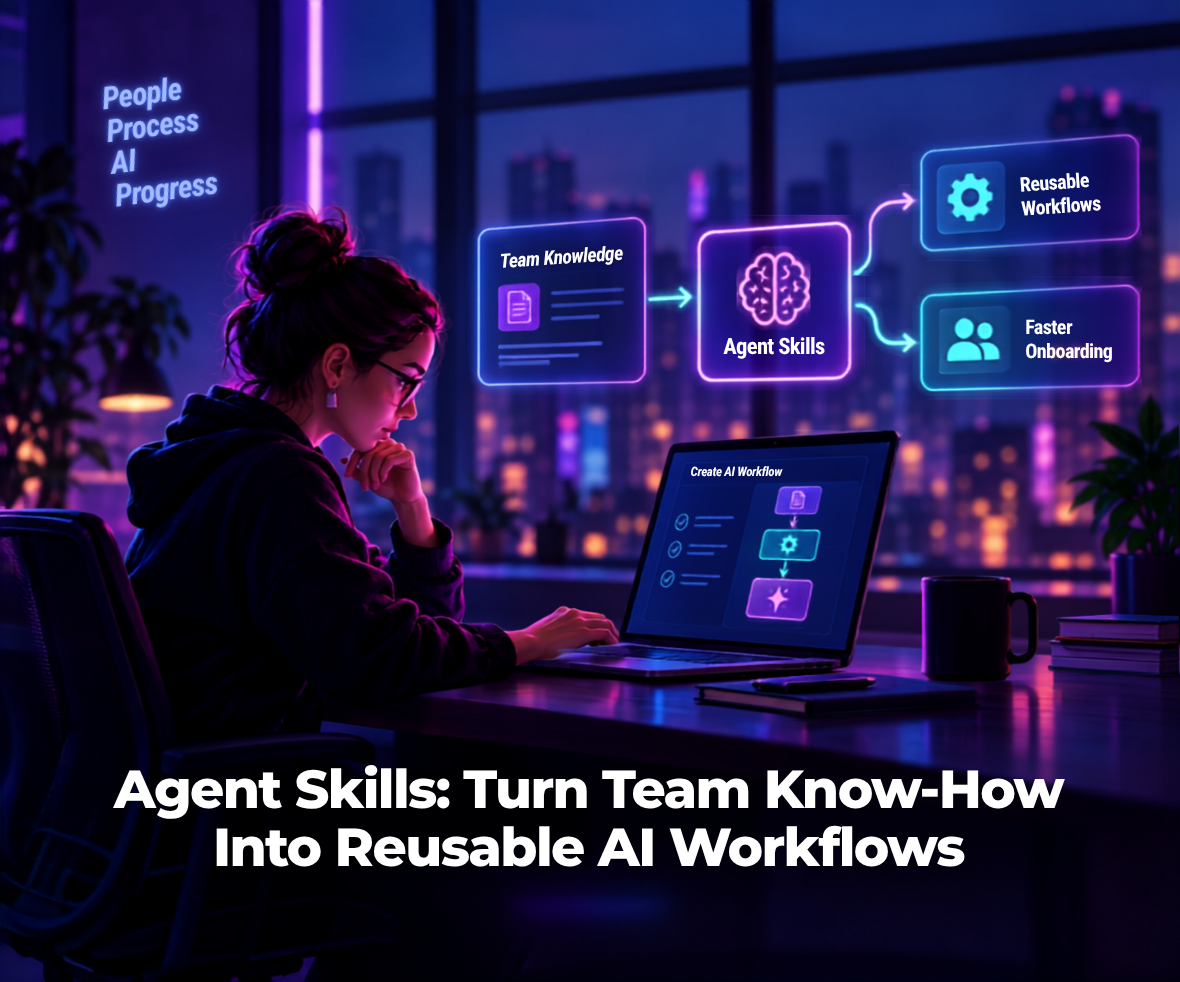

Teams rarely lose workflows because they are impossible to document. They lose them because the details stay scattered across prompts, checklists, files, and employees’ heads. Agent Skills give teams a way to package that know-how so AI can reuse it.
That shift matters as companies move from occasional AI assistance to repeatable agent workflows. The harder question is no longer whether a model can complete a task. It is whether the system can follow the team’s preferred method, use the right references, and stop at the right review points.
That is where Agent Skills become useful. This article explains what belongs in a Skill, how Skills differ from prompts and MCP, and what should still stay human.
TL;DR
- Agent Skills package reusable operating methods around recurring work: instructions, references, scripts, templates, and decision rules.
- The strongest AI Agent Skills start with a workflow the team already understands. A Skill should encode a method, not invent one.
- Good Skill candidates are repeated, stable, explicit, and reviewable.
- Skills carry reusable instructions and resources. MCP standardizes connections to tools and data; permissions and approvals still depend on the systems involved.
- A Skill library needs ownership and testing because workflows, APIs, permissions, and quality standards change.
What Are Agent Skills?
Agent Skills are reusable packages that give an AI agent instructions and supporting resources for a specific task. In the open Agent Skills format, each skill contains a SKILL.md file with a name, description and instructions. It can also include scripts, reference documents and templates. The agent uses these resources within the capabilities and permissions of its host application.
Anthropic introduced Agent Skills in October 2025 as organized folders of instructions, scripts, and resources. At the simplest level, a Skill contains a SKILL.md file that tells the agent when the workflow is relevant and how to run it.
OpenAI uses the same broad idea for ChatGPT Skills: save the “how” once so a recurring workflow can be reused consistently. Its guidance describes SKILL.md as the playbook for a workflow, covering instructions, required inputs, output requirements, resources, and final checks.
The file format is useful. The bigger shift is operational: a team’s preferred way of doing the work becomes explicit enough to reuse, inspect, and improve.
Why Are Skills More Useful Than Reusing a Prompt?
Agent Skills become more useful than a reused prompt when quality depends on a repeatable sequence, shared references, exceptions, and review conditions.
A prompt is usually scoped to the current interaction. Teams still end up copying it, attaching the same examples, correcting the same omissions, and reminding the model which rules matter.

Anthropic’s Claude Skills documentation describes progressive disclosure: metadata stays available for discovery, the full SKILL.md instructions load when the Skill becomes relevant, and supporting resources can be accessed only when needed.
That separates the reusable method from the conversation happening right now.
If a team keeps reusing the same prompt and correcting the same misses, I would stop asking, “How do we improve this prompt?” and ask, “Has this become a workflow we should package?”
Which Workflows Should Become Agent Skills?
The best Agent Skills candidates are repeatable, reviewable, and already understood by the team. Experienced people should broadly agree on how the task runs and what a good result looks like.
Our rule of thumb is simple: a Skill should encode a method the team already trusts. It should not be where the team invents the method.
Useful Agent Skills examples include recurring research, reporting, design-system checks, release QA, content review, and account preparation. The common factor is a method the team can describe and evaluate.
Four filters help narrow the list:
-
Frequency: The task appears across weeks, projects, or accounts.
-
Stable method: The team follows a known playbook or checklist.
-
Explicit rules: The team can document inputs, exceptions, approved sources, and review conditions.
-
Observable quality: A reviewer can tell whether the output meets the standard.
This is the same discipline teams need when they build their first AI agent. A narrow scope makes permissions, evaluation, and human handoffs easier to define.

How Do Agent Skills Turn Workflows Into Reusable AI?
Teams create useful Agent Skills by documenting the real process before they automate it. The build should make inputs, decisions, resources, exceptions, and completion criteria explicit.
1. Start With a Workflow That Already Works
Choose a task the team has completed enough times to understand where the real decisions happen.
When Google launched its official Agent Skills repository in April 2026, it started with 13 Skills covering products such as BigQuery, Firebase, the Gemini API, Cloud Run, and GKE, alongside recipe-style workflows.
A narrow workflow gives you real choices to encode. “Help with marketing” does not. “Turn this approved campaign brief into platform-specific drafts using these voice rules and this review checklist” does.
2. Capture What Experienced People Know
Write down the decisions skilled team members make almost automatically.
Which source wins when two numbers disagree? Which template applies? Which claim needs approval? When should the agent stop and ask a person instead of improvising?
This is where custom Agent Skills become useful. Internal Skills can carry team-specific terminology, templates, decision rules, source priorities, and quality standards.
3. Separate the Method From Supporting Resources
Keep the core workflow readable, then attach references, examples, schemas, and scripts only where needed.
That separation makes maintenance easier. A team can update one template, reference file, or script without rewriting the whole workflow.
Anthropic’s Skill authoring guidance follows the same pattern: keep SKILL.md focused and move detailed supporting material into separate resources that can be loaded as needed.
4. Define What Done Means
Acceptance criteria should exist before execution, not after someone dislikes the output.
Define required fields, source checks, approval gates, escalation triggers, and conditions that should stop the workflow entirely.
Once the Skill starts calling tools or making changes across systems, those rules become part of the wider AI agent architecture. Permissions, retrieval, observability, recovery paths, and human review still determine whether the workflow is ready for production.
If your team is still deciding which workflows are stable enough to standardize, an AI Innovation Strategy exercise can help separate good Skill candidates from processes that still need redesign before automation.
Agent Skills vs MCP, Tools, Prompts, and Agents
Agent Skills define a reusable method. MCP standardizes connections between an AI application and external capabilities. A tool performs a specific operation, while an agent coordinates the task. These parts can work together.
| Layer | Primary role | Best fit |
|---|---|---|
| Prompt | Supplies instructions or context for a request | A task request or reusable instruction template |
| Agent Skill | Packages task instructions and supporting resources | A repeatable method with defined inputs and checks |
| MCP | Standardizes communication with servers exposing tools, resources and prompts | Connecting an AI application to external capabilities |
| Tool | Performs a specific operation | Retrieving data, running a calculation or executing an authorized action |
| Agent | Coordinates reasoning and actions toward a task | Work that may use skills and tools |
A reporting skill can define the metrics, source checks and report structure. The agent can use a reporting tool exposed through an MCP server to retrieve the data, provided that the connection and the required permissions have been configured.
MCP does not, by itself, guarantee safe or authorized execution. Access controls, approval rules and execution safeguards depend on the host application, server and connected systems. A skill can describe review requirements, but the execution environment must still support them.

This distinction matters during production integration, when AI has to work with real infrastructure, product interfaces, user permissions, and operating constraints rather than a controlled demonstration.
How Do Claude Skills and ChatGPT Skills Fit the Same Model?
Claude Skills and ChatGPT Skills both package repeatable ways of working, even though their product implementations and execution environments are not identical.
For teams asking “what are Claude Skills,” the practical answer is simple: they package instructions, code, references, and supporting resources that Claude can load when a relevant task appears.
Anthropic published Agent Skills as an open standard on December 18, 2025, extending the format beyond its original Claude implementation.
OpenAI’s Skills guidance describes the same operating goal in ChatGPT: reusable workflows built around instructions, SKILL.md, resources, required inputs, expected outputs, and final checks. OpenAI describes it SKILL.md as a portable, open-standard format, although installation, execution, permissions, and product support can still differ across AI environments.
For a team deciding where to start, the platform question is secondary. First ask whether the workflow is stable, repeatable, specific, and reviewable enough to encode.
Otherwise, you are standardizing uncertainty.
What Do Agent Skills Examples Look Like in Practice?
Good Agent Skills examples make the input, method, boundaries, and reviewable output obvious.
A reporting Skill might take analytics exports, compare an approved set of metrics, flag material changes, apply the team’s reporting structure, and stop if a required source is missing.
A design-system Skill might check token usage, component selection, accessibility rules, and documented exceptions before producing a review for a designer or engineer.
A research Skill could define source priorities, freshness requirements, evidence thresholds, exclusions, and synthesis rules before producing a decision-ready brief.
These examples work because the agent is not simply told to “do research” or “review the design.” It is given a method someone can inspect and evaluate.
Custom Agent Skills are especially useful for workflows that would not make sense as public templates: proprietary proposal processes, internal review gates, account-specific reporting standards, or sector-specific compliance checks.
Worked Example: A Design-Handoff Review Skill
This illustrative skill reviews a design handoff against approved guidelines. It produces findings for a designer to evaluate; it does not change the design file or certify accessibility compliance.
Inputs: An exported screen set or accessible design file, the approved component guidelines and a handoff checklist.
Method: Compare the supplied screens with the guidelines. Flag missing loading, empty, and error states; identify component deviations; and record unspecified responsive requirements. If a source is missing or unreadable, report that limitation instead of inventing a rule.
Output: A review table containing the screen or component, the finding, the supporting reference and the suggested next action.
Sample finding: Checkout/payment failure — the supplied screen set shows a success state but no failure state. Confirm whether a separate error-state design exists before asking the designer to add one.
Human review: A designer checks each finding, resolves documented exceptions, and decides which changes are appropriate. Access to a design application requires a supported tool and permission; the skill file alone does not provide that access.
How Should Teams Maintain an Agent Skill Library?
An Agent Skill library still needs ownership and testing. As APIs, templates, permissions, and operating standards change, the Skill should be retested against representative tasks rather than treated as finished documentation.
A smaller team can use the model:
- Assign an owner for each workflow and its updates.
- Version material changes so people know which operating method the Skill represents.
- Test representative tasks before rollout and after major updates.
- Review APIs, URLs, templates, permissions, and tool access.
- Keep consequential actions behind approval until evidence supports more autonomy.
Security belongs in the same review. Anthropic recommends using Skills only from trusted sources because Skills can contain instructions and executable code, and a malicious Skill could direct an agent to invoke tools or execute code in unintended ways.
Third-party Skills deserve the same caution you would give an unfamiliar script or integration.
The wider AI agent development process follows the same logic: define autonomy boundaries, test in controlled environments, review permissions, add observability, and expand responsibility only when the evidence supports it.
The Skill is reusable. Trust still has to be earned.
Conclusion: Make the Method Reusable. Keep the Judgment Human.
Agent Skills matter because they move AI from repeated instruction toward reusable operating knowledge. The strongest AI Agent Skills capture a process the team already trusts, then make its rules, references, exceptions, and completion criteria explicit.
That does not remove the need for people. It makes the division of work clearer. The Skill handles the repeatable method, while people keep ownership of judgment, exceptions, and consequential decisions.
Start with one workflow your team repeats often and can evaluate objectively. Map it before you automate it. An unclear process only makes the ambiguity repeatable.
Which workflow should your team standardize first?
If your team is deciding whether a repeated process needs a Skill, an agent, or a redesign before either, ProCreator can help map the workflow, define where human judgment still belongs, and shape the right AI approach around the product.
Start an AI strategy conversation with ProCreator →
FAQs
What Is the Difference Between a Prompt and an Agent Skill?
A prompt usually tells an AI what to do in the current interaction. An Agent Skill packages a reusable way of doing the work, including instructions, references, exceptions, and quality checks. If your team keeps reusing the same prompt and correcting the same mistakes, the workflow may be a better candidate for a Skill. Pasted markdown
How Do Agent Skills Work?
Agent Skills give an AI a structured method it can use when a relevant task appears. The Skill defines the workflow, required inputs, supporting resources, exceptions, and completion criteria. Depending on the platform, instructions and resources can be loaded when needed, while tools and permissions determine what actions the AI can actually perform. Pasted markdown
Are Agent Skills Platform-Specific?
Not necessarily. The Agent Skills format is designed to make reusable workflows portable, but each AI platform can implement Skills differently. Claude, ChatGPT, and other environments may differ in how Skills are installed, loaded, executed, and connected to tools. The reusable method can travel; the surrounding permissions and execution environment may not. Pasted markdown
What Is the Difference Between Agent Skills and MCP?
Agent Skills package reusable instructions and resources for a task. MCP standardizes how an AI application connects to servers exposing tools, resources and prompts. A skill may guide when to use an MCP-connected tool, but access permissions and approval controls must still be configured in the systems involved.


