
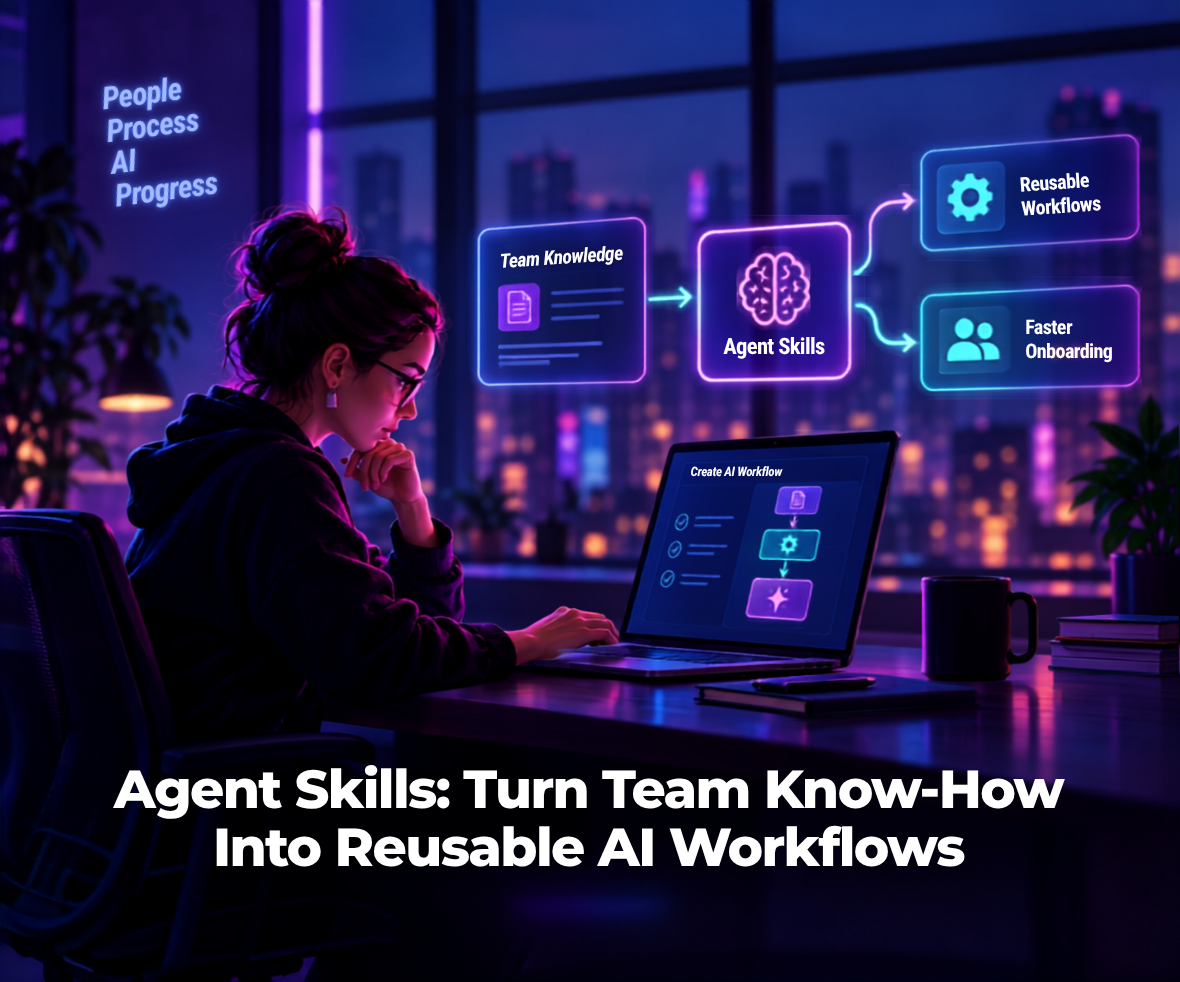

Teams rarely lose workflows because they are impossible to document. They lose them because the details stay scattered across prompts, checklists, files, and employees’ heads. Agent Skills give teams a way to package that know-how so AI can reuse it.
That shift matters as companies move from occasional AI assistance to repeatable agent workflows. The harder question is no longer whether a model can complete a task. It is whether the system can follow the team’s preferred method, use the right references, and stop at the right review points.
This article explains what Skills are, what work belongs in them, how they differ from prompts and MCP, and how teams can maintain them without automating judgment that should stay human.
TL;DR
-
Skills capture reusable operating methods by packaging instructions, references, scripts, templates, and decision rules around recurring work.
-
AI Agent Skills work best when the workflow is already understood because the Skill encodes a method instead of inventing one.
-
The best Skill candidates have clear inputs and review criteria so teams can judge whether the output is correct.
-
Skills and MCP solve different parts of the system because Skills carry process while MCP provides access to tools and data.
-
Skill libraries need ownership and testing because workflows, APIs, and organizational rules change over time.
What Are Agent Skills?
Agent Skills are reusable packages that teach an AI system how to perform a specific kind of work. A Skill can combine instructions with references, scripts, templates, and other resources that load when needed.
AI Agent Skills give a general-purpose agent procedural context for recurring work. Instead of relying only on what the model already knows, the Skill can tell it which process to follow, which resources to use, and which rules should govern the output.
In its Agent Skills launch, Anthropic introduced the format in 2025 for packaging instructions, scripts, and resources around specialized work. A Skill usually starts with a SKILL.md file that defines when to use the workflow and how to perform it.
Google extends the model through its official Skills repository, which includes Skills for BigQuery, Firebase, Gemini API, Cloud Run, and GKE.
Why Are Skills More Useful Than Reusing a Prompt?
A prompt handles the current interaction. A Skill preserves the method behind recurring work. That matters when quality depends on the same sequence, references, exceptions, and checks.

Anthropic’s Claude Skills documentation describes progressive loading of metadata, instructions, and supporting resources. Teams do not have to paste the full operating context into every conversation when the Skill can supply it when relevant.
If teams keep reusing the same prompt and correcting the same omissions, the workflow may be a stronger Skill candidate than a one-off prompt.
Which Workflows Should Become Agent Skills?
The best Agent Skills candidates are repeatable, reviewable, and already understood by the team. Experienced people should broadly agree on how the task runs and what a good result looks like.
Useful Agent Skills examples include recurring research, reporting, design-system checks, release QA, content review, and account preparation. The common factor is a method the team can describe and evaluate.
Four filters help narrow the list:
-
Frequency: The task appears across weeks, projects, or accounts.
-
Stable method: The team follows a known playbook or checklist.
-
Explicit rules: The team can document inputs, exceptions, approved sources, and review conditions.
-
Observable quality: A reviewer can tell whether the output meets the standard.
This is the same discipline teams need when they build their first AI agent. A narrow scope makes permissions, evaluation, and human handoffs easier to define.

How Do Agent Skills Turn Workflows Into Reusable AI?
Teams create useful Agent Skills by documenting the real process before they automate it. The build should make inputs, decisions, resources, exceptions, and completion criteria explicit.
1. Start With a Workflow That Already Works
Choose a task the team has completed enough times to understand. Google followed this pattern with product Skills for BigQuery and Firebase and recipe Skills for onboarding, authentication, and network observability.
A specific workflow gives you real decisions to encode. A broad instruction does not.
2. Capture What Experienced People Know
List the decisions a skilled team member makes without thinking, including which source to trust, which template to use, and when to escalate.
This is where custom Agent Skills become useful. A public Skill can encode a general method, while an internal Skill can carry team-specific terminology, templates, decision rules, and quality standards.
3. Separate the Method From Supporting Resources
Keep the core workflow concise, then attach templates, schemas, examples, and scripts only when needed. Anthropic’s progressive disclosure model follows the same pattern.
That structure also makes internal Skills easier to maintain because teams can update one reference or script without rewriting the whole method.
4. Define What Done Means
Set acceptance criteria before the Skill runs. Cover required fields, source checks, calculations, escalation points, and approval gates.
Once the Skill starts calling tools or making changes across systems, these rules become part of the wider AI agent architecture. Permissions, retrieval, guardrails, memory, observability, and recovery paths still determine whether the workflow remains reliable in production.
Agent Skills vs MCP, Prompts, and Agents
The Agent Skills vs MCP comparison is not about choosing one over the other. Skills, MCP, prompts, and agents solve different problems inside an agentic system.
| Layer | Primary role | Best fit |
|---|---|---|
| Prompt | Gives instructions for the current interaction | One-off requests or temporary context |
| Agent Skill | Packages a reusable method, rules, and resources | Repeatable work with a known process |
| MCP or tool | Gives access to systems, data, or actions | Retrieval, integrations, and execution |
| Agent | Reasons through and carries out the task | Multi-step work that uses Skills and tools |
A reporting Skill could define which metrics to compare and how to structure the report. MCP could give the agent access to the analytics platform where those metrics live.
Framed this way, Agent Skills vs MCP becomes a question of responsibilities inside the workflow. The Skill carries procedural knowledge. MCP provides governed access.

This distinction matters during production integration, when AI has to work with real infrastructure, product interfaces, user permissions, and operating constraints rather than a controlled demonstration.
How Do Claude Skills and ChatGPT Skills Fit the Same Model?
Both products apply the broader idea of making recurring ways of working reusable. The implementation differs, but the operating principle stays similar.
For teams asking “what are Claude Skills,” the short answer is that they package instructions, code, templates, and references that Claude can load when a relevant task appears. In organizational terms, what are Claude Skills if not a way to turn selected operating knowledge into reusable context?
Anthropic published the Agent Skills format as an open standard in December 2025, making the workflow itself more important than the interface where it first runs.
ChatGPT Skills follow a similar model. Teams should ask whether the workflow is stable, repeatable, and specific enough to encode before they focus on the mechanics of packaging it.
The same reasoning helps answer what Claude Skills are without reducing them to a feature checklist. They are useful when a team has procedural knowledge worth preserving and applying consistently.
What Do Agent Skills Examples Look Like in Practice?
The strongest examples show a clear input, a defined method, and an output someone can review. They make the encoded process visible instead of treating the Skill as a black box.
A reporting Skill might compare analytics exports and produce a weekly summary. A design-system Skill might check tokens, component usage, accessibility rules, and implementation exceptions.
A research Skill could define source priorities, evidence thresholds, and synthesis rules. These Agent Skills examples work because each workflow has explicit rules and a reviewable output.
Teams can also create custom Agent Skills for workflows that would not make sense as public templates, such as proprietary proposal processes or regulated review checklists.
How Should Teams Maintain an Agent Skill Library?
An Agent Skill library needs ownership, testing, and review. A workflow can become stale when the underlying API, policy, template, or quality standard changes.
Google uses automated checks, evaluation suites, and recurring quality reviews. Remigiusz Samborski describes a Skill as “a living product, not a one-off document.”
A smaller team can use the model:
-
Assign an owner for each workflow and its updates.
-
Version material changes so people know which process the Skill represents.
-
Test representative tasks before rollout and after major changes.
-
Review dependencies such as APIs, URLs, templates, and permissions.
-
Keep risky actions behind approval until testing supports more autonomy.
Security belongs in the same review. Anthropic warns teams to treat Skills like software because they can contain code and instructions that invoke tools.
The wider AI agent development process follows the same logic. Teams need autonomy boundaries, sandbox testing, permissions, governance review, observability, and staged rollout before moving from assisted work toward autonomous execution.
Conclusion: Agent Skills Make Team Know-How Reusable
Agent Skills matter because they move AI from repeated instruction toward reusable operating knowledge. The strongest AI Agent Skills capture a process the team already trusts, then make its rules, references, exceptions, and completion criteria explicit.
That does not remove the need for people. It makes the division of work clearer. The Skill handles the repeatable method, while people keep ownership of judgment, exceptions, and consequential decisions.
Start with one workflow your team repeats often and can evaluate objectively. Map it before you automate it. An unclear process only makes the ambiguity repeatable.
If you need help deciding which AI workflows are worth standardizing before you build, ProCreator’s AI innovation strategy service can help map high-value use cases, define workflow boundaries, and turn them into a practical implementation roadmap.
FAQs
What Are Claude Skills?
Claude Skills package domain workflows and resources that Claude can load when relevant. They can include instructions, scripts, references, and organization-specific context that helps Claude follow a repeatable method.
What Are ChatGPT Skills?
ChatGPT Skills package recurring instructions and supporting resources so ChatGPT can apply a known workflow when the task calls for it. These Skills are most useful when a team already has a repeatable method rather than a one-off request.
What Are Agent Skills Examples?
Examples include reporting, research preparation, design-system review, release QA, content checks, and workflow-specific analysis. Strong Skills share the same pattern: a clear input, an explicit method, known exceptions, and an output that a person can evaluate.
What Is the Difference Between Agent Skills and MCP?
Agent Skills vs MCP comes down to role. Skills define how a workflow should run, while MCP gives an agent controlled access to tools, systems, or data needed during that workflow. Teams often need both.


